

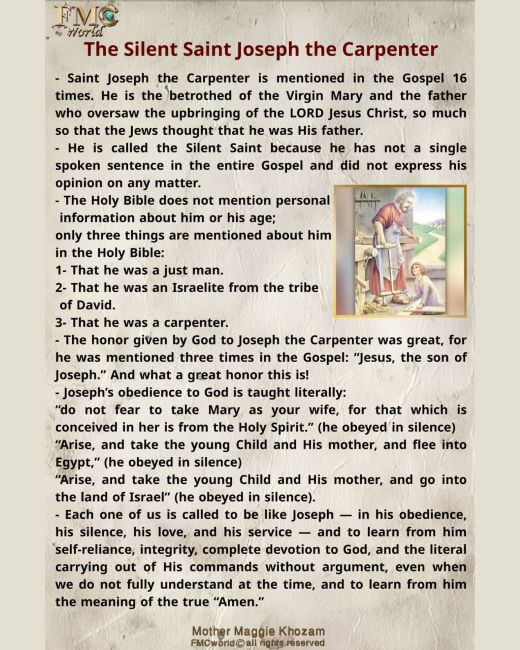
He is the betrothed of the Virgin Mary and the father and caretaker of the LORD Jesus Christ, and the Jews thought that he was His father.
It befits this saint that we contemplate his life and holiness, remember him, and bless him as befits all the saints of the LORD Jesus Christ, for he is worthy of this.
Joseph the Carpenter is mentioned in the Holy Bible sixteen times; nevertheless, we do not know much about him — neither his age, nor the time of his death, nor when he took the Virgin Mary into his home, nor the identities of his relatives — because the Holy Bible primarily sheds light on the Savior, the LORD Jesus Christ.
As for the remaining accounts about Joseph, whether it is said that he was an old man or a young man, all these matters are unproven, and it is most likely that some Christian denominations invented such stories to appease Muslims. They would say to you: “Ha! You have Joseph who took Mary when he was ninety years old, while she was young,” and this claim is completely false and is not mentioned in the Gospel concerning Saint Joseph the Carpenter.
The Holy Bible tells us three important things about Saint Joseph:
1. That he was a just man.
2. That he was an Israelite from the tribe of David.
3. That he was a carpenter.
Saint Joseph the Carpenter raised Jesus Christ in a self-reliant manner, in a way that made Him depend on Himself, and through this, he also taught us to rely on ourselves.
Joseph the Carpenter taught us that he was the one who carried the Gospel — the Good News — in his hands, for Christ is the Gospel, whom Joseph carried in his hands. Yet despite this, Joseph did not covet anything from the Magi when they came and brought gifts; he did not ask for anything for himself, nor did he seek favor from the king. Rather, he carried out the words of the LORD God literally as they were commanded to him, without any earthly ambitions, without arrogance, and without any heroic attempt to say: “I am the one here who oversees the upbringing of the Son of God.” On the contrary, Saint Joseph lived in the shadows and was called “the Silent Saint,” because he had not a single spoken sentence in the entire Gospel and did not express his opinion on any matter. Through this, this wonderful, silent saint — the true hero, Joseph the Carpenter — teaches us to follow the LORD God completely, without question, but to obey, even if we don’t understand one hundred percent, trusting in the One whom we know understands perfectly and who has given us a specific command to fulfil.
Thus, we notice how the angel said to him: “Do not fear to take Mary as your wife, into your home,” and he took her, even though this matter was a very heavy burden, and perhaps if the Jews had known that his betrothed was pregnant, they might have stoned him. He himself, when he learned that she was pregnant, intended “to put her away privily” so as not to expose her, because he was a just man. Another person in his place might have thought only of clearing his own name and shown no concern for her, perhaps even demanding punishment against her. But Joseph was righteous and wished “to put her away privily,” had not the angel of the LORD said to him: “Joseph, do not fear, for the One conceived in her shall be called the Son of the Highest, and she is with Child by the Holy Spirit.” So, he arose, carried out the command, and took her into his home in silence. Then the angel appeared to him again in a dream and said: “Arise, and take the young Child and His mother, and flee into Egypt,” and with the same silence and obedience, the Holy Bible says: “he arose, he took the young Child and His mother” Then the angel again said to him: “Arise, and take the young Child and His mother…for they are dead which sought the young Child’s life.” And he arose, took the Child and His mother, and returned also in silence.
Perhaps we may see the situation as though he was greatly wronged, since even the disciples and apostles of the LORD were mentioned in the Holy Bible more than he was. But in truth, the honor given by the LORD God to Joseph the Carpenter was great. For the Gospel mentions Joseph three times with the words: “Jesus, the son of Joseph,” and all the people, including the Jews, knew that Jesus was the son of Joseph. And what greater honor is there than for Joseph to be mentioned as the earthly father of the Son of God?!
Joseph is a calling for us as Christians to imitate him — in his obedience, his silence, his love, and his service; in his self-reliance, his integrity, and in the “Amen” that he said.
Some time ago, someone asked me and said: “You say that it is not permissible for us to deify the saints, that it is not permissible to dedicate our children to them, and that it is not permissible to say: ‘O saint, protect me and heal me.’ So then, how do you bless and honor a saint?!”
Today, in this article, I have answered you: this is how we honor our saints — by remembering how they lived so that we may imitate them. You may name your son Joseph, but you may not dedicate him to Saint Joseph, because a vow is only to the LORD God. By dedicating your child to someone, you are making that person or saint your god.
And you may not offer a sacrifice to Saint Joseph, because sacrifices — even though they were abolished with the sacrifices of the Old Testament — are offered only to the LORD God.
You may also place a symbolic Nativity scene that includes the figure of Joseph, even though all these images are not real but are merely imaginings and artistic depictions of saints. You may place them in the home, but you may not kiss them, nor ask anything from them, nor bow before them, nor place your expectation, hope, or trust in these images and statues. Anyone who thinks that he honors a saint in this way is, in fact, deifying him; and thus, you will offend the saint, yourself, and Christianity in general, because the Holy Bible tells us that we have one intercessor and one mediator between the Creator, the Heavenly Father, and people, and that is the LORD Jesus Christ, the Son and we have the Holy Spirit, who “maketh intercession for us with groanings which cannot be uttered.”
Therefore, the LORD God Himself is the greatest intercessor for us, and when you turn to other intercessions, it is as though you are saying to Him: “I do not want Your intercession, O Holy Spirit!” — and here you must bear what will come upon you.
May the LORD preserve your children who bear the name “Joseph.” We can, of course, name our children after the saints of the LORD — and how beautiful these names are — but what is most important is that we teach our children to be like Joseph the Carpenter.
March / 19 / 2022